This article was originally published in CUNY FORUM Volume 12:1 “Re-generations and Re-tellings: Fifty Years after the Fall of Sài Gòn”.
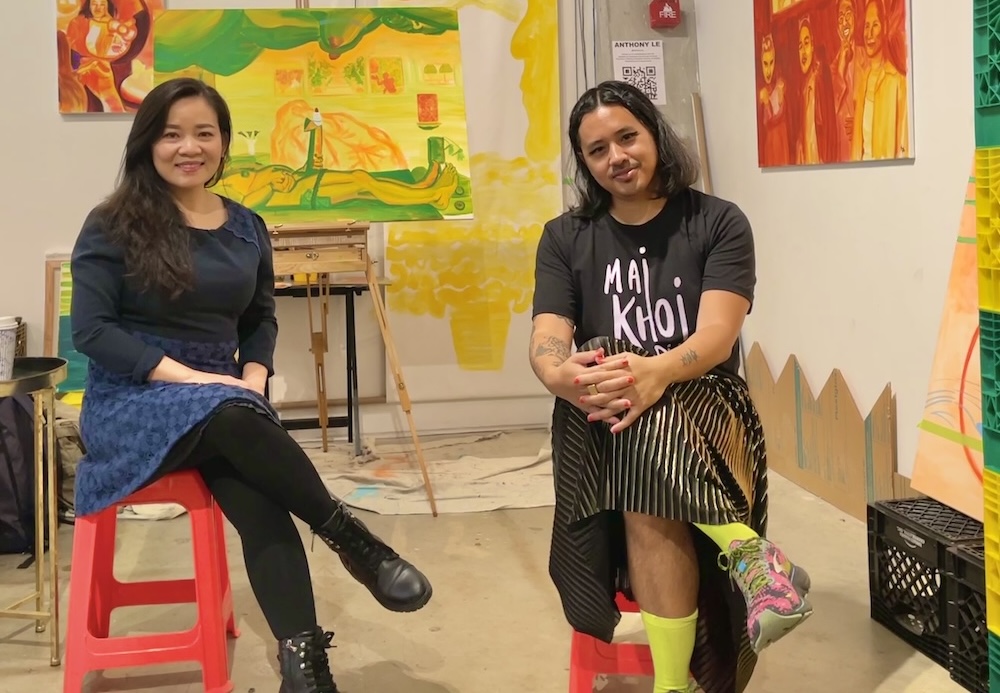
IN WASHINGTON, D.C., ANTHONY LÊ (HE/THEY), a Vietnamese American non-binary queer artist, finds sanctuary in their Playhouse studio. More than a workspace, it is a crucible where histories and identities fuse into a potent aesthetic. Anthony views art as a bloom of personal odyssey. In their cosmos, every piece laments, roars, and presses the question of injustice: “Why? Oh, why?” Their pursuit is one of disentanglement—fracturing history and identity to unfurl subliminal layers.
Perhaps no torment cuts deeper than estrangement from a place one calls home. Perhaps because belonging is never a mere choice—or because alienation has long been institutionalized, teaching fear over trust, hostility over love, destruction over creation—estrangement appears, at first glance, to be the very force that severs us from belonging itself. This visceral rupture, this inhabiting of a liminal space, defined Anthony’s early life and became a foundational theme in their art. Against this backdrop, Anthony would later, first implicitly and then explicitly, coin the phrase “Model Mutiny,” a direct and forceful rejoinder to the insidious myth of the “Model Minority.” That stereotype, often imposed on Asian Americans, casts them as inherently diligent, compliant, and successful—a narrative used to dismiss the struggles of other marginalized groups and to deny systemic racism. By flattening individuality and enforcing conformity, the Model Minority myth estranges even as it praises. Anthony’s Model Mutiny, in contrast, names and enacts rebellion: a refusal of imposed expectations, and a reclamation of self from the alienation they produce.
Their heritage, a constant undercurrent in their artistic process, is both an inheritance and a mosaic of tesserae shaped from displacement, resilience, and aspiration. Born in Chattanooga, Tennessee, Anthony is not a refugee themself, yet the echoes of their parents’ harrowing escape from Việt Nam after the war resonate deeply within them. For thirty-seven years, the specifics of that journey remain largely unspoken, a void in their genesis narrative. This absence, they realize, compels them to construct their own assumptions about the past, to build a self on a scaffolding of imagined history—a subtle but profound estrangement from their own roots. This unacknowledged mutiny against silence will, in time, animate their artistic voice.
In 2024, a wedding in Boston brought Anthony together with their siblings and father. The gathering opened a space for conversations long overdue. Their father, who had left everything behind without a farewell, began to tell his story: the scramble as Sài Gòn fell, the desperate flight on rickety boats, the arrival in the Philippines, months of silence before family contact, and finally the plane ride to America, landing in an Arkansas refugee camp. From this journey, a memory of loss took shape—etched not in Anthony’s own life, but inherited from their parents’ sorrow.
It is there, in a twist of fate that defies Anthony’s preconceived notions, that their parents meet through a mutual friend. Their courtship is an intimate exchange of letters across states—Anthony’s father in New Jersey, their mother in Michigan. And then, the symbolic convergence on the Fourth of July in Michigan, a date etched in Anthony’s memory with newfound significance. This national holiday, which in the urban sprawl of D.C. often feels like an annoying, tourist-laden spectacle, and jingoistic display that grates against their artist’s questioning of patriotism, now holds a different resonance. It is the day their family, in a fragmented yet hopeful beginning, comes together. This newfound memory, imbued with the unexpected beauty of genesis amidst nationalistic fanfare, lingers in their perception—a counter-narrative to the dominant, often exclusionary, American story. It is an early, unconscious Model Mutiny against the singular American ideal.
Chattanooga, where Anthony’s engineer father and seamstress/hair salon–owner mother eventually settle for a job opportunity, presents countless ordeals. A place with few Vietnamese people, it demands assimilation. Anthony is raised speaking Vietnamese at home, a language that, with distance and time, erodes, leaving them with understanding but a hesitant tongue. The loss of confidence to speak their mother tongue deepens their struggle with identity and estrangement from a vital part of themself.
Assimilation, they understand, is a survival tactic, a necessary adaptation in a world that often threatens to engulf. Yet, in Chattanooga, it takes on a particular hue. Their parents, seeking a perceived safety, align with the dominant “whiteness,” a privilege tied to class that, to Anthony’s discerning eye, also fosters an implicit anti-Blackness they observe growing up. This is further amplified by their transition from a diverse public school to a private one, filled with “rich white kids.” Survival mode becomes their default, leading to a subtle rejection of their heritage. This is a direct consequence of the institutionalized alienation that forces Anthony’s parents to seek perceived safety in assimilation, and imposes upon Anthony a profound sense of otherness—a form of mutiny against their own being. This early experience of forced conformity cements the need for a Model Mutiny in their future.
The constant questions about their Vietnamese background, often tied to the American media’s myopic, war-centric narrative of Việt Nam, feel intrusive. They pry at a history Anthony doesn’t fully possess, answers they cannot provide, leading to a profound sense of shame that curdles into anger and frustration. They bury it down, refusing to speak of it. Chattanooga, in their youthful mind, is simply “not for me.” The truth, the artist realizes later, is that they don’t know where they come from, and this gap in memory fuels a profound melancholy.
College at Penn State, despite its pastoral serenity, expands their mind—more Asian faces, a space of cultural intimacy. Then comes D.C. in 2009, a city they love for its walkability and vibrant energy. It is here, in 2018, that their artistic journey truly begins, shaped by a pivotal shift profoundly influenced by their partner, Ashley J. Williams, also an artist. When two artists build a life together, art becomes “a kind of religion,” a compass for navigating the world.
Their Catholic upbringing, though now a past identity, instills in them implicit rules, a “queer gaze” they fundamentally disagree with. As an artist, they question everything, and this questioning extends to upbringing, values, and heritage. Their art practice, therefore, becomes an exploration of heritage, a process of “learning and unlearning.” While understanding what happens to them and their family is important, the more crucial question for Anthony is, “How do we live better?” This is not about painting beauty for its own sake; if one visits the artist’s virtual gallery, after a few moments of rapture by tropical colors in every artwork, one is dazzled by the messages implied by the artist in every detail of their art. For years, the artist has spread their strokes on disturbing realities of their surroundings. This artistic pursuit is, in itself, a form of Model Mutiny, challenging passive acceptance through vibrant interrogation.
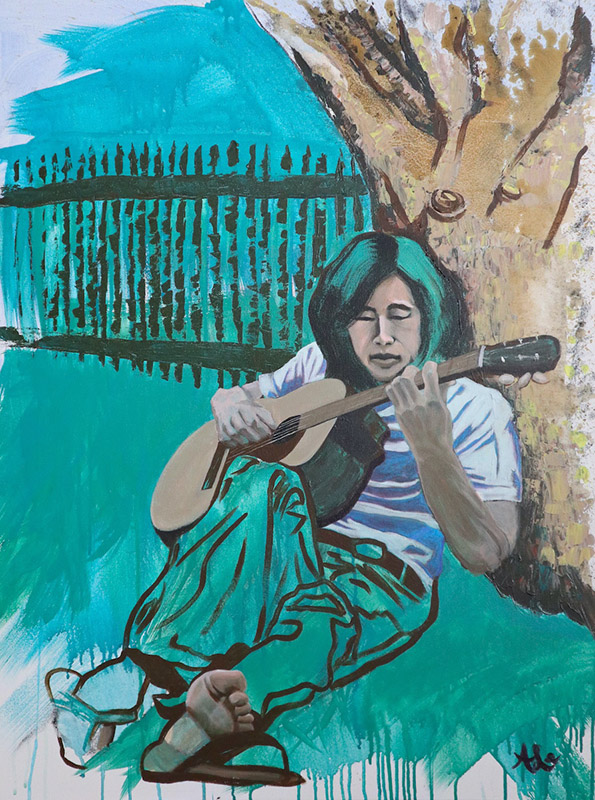
Their early paintings often draw from old family photos, depicting scenes such as their father in New Jersey with long hair, playing a guitar—an image imbued with “romanticism about what’s ahead.” These works capture the “American dream” their father embraced, a sense of “all this potential” before meeting their mother. They are not merely nostalgic renderings but acts of reclaiming memory, carrying the subtle melancholy of what might have been and the unspoken losses that shaped the path forward.
A second trip to Việt Nam in 2019, this time with friends, casts Anthony’s first family visit in 1996 into sharp relief. The years have transformed the country, and with that transformation comes a vague sense of unrest—navigating alone, not speaking the language, wondering if they might find in this “motherland” a sense of belonging they have never known in America. The answer is subtle but definitive: no one there sees them as Vietnamese; they see only an American. Initially jarring, this realization proves “necessary.” “There is no truth lying out there that I don’t know about myself,” they reflect. “I am who I am, and the sooner I accept that, the better I’ll be going forward.” In this acceptance, they perform a mutiny against identities imposed from the outside—a pivotal moment in their personal Model Mutiny.
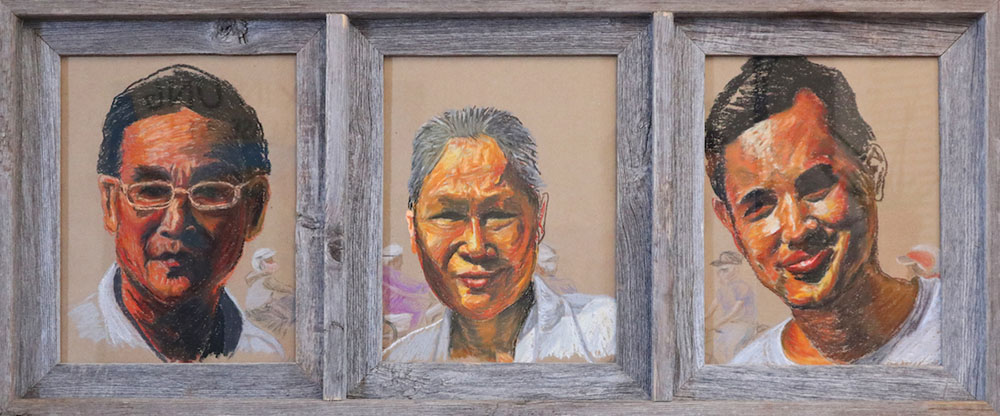
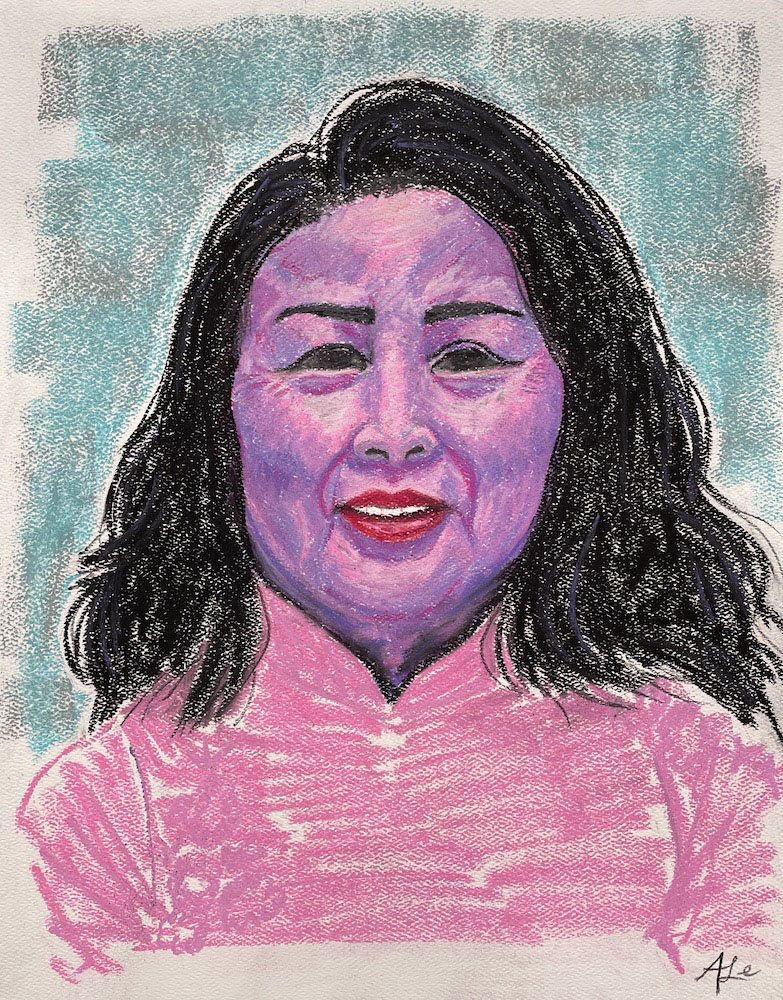
This trip unveils multiple facets of the Vietnamese experience as the country has been transformed by its fierce capitalism. There, Anthony observes a paradox: greater wealth and power for Việt Nam, yet ongoing suppression of free speech. The story of Vietnamese musician and human rights activist Mái Khôi, whom they have the privilege to meet, powerfully illustrates art’s political potency. Khôi’s journey—from a government-favored artist to one censored for speaking out against human rights abuses—shows how art can both serve propaganda and become a formidable force against it. This resonates deeply with Anthony and compels them to wonder what their life might have been like had they grown up in Việt Nam and pursued a similar artistic path. The political tempest—the violent moments that intensify torment—fails to yield a compassionate community, one that might nurture life and creativity over fear and displacement, flourishing over death. Tragically, the forms of monstrosity that marked a century of bloodshed and trauma begin to reappear in new guises—or in ways that surpass even their earlier specters.
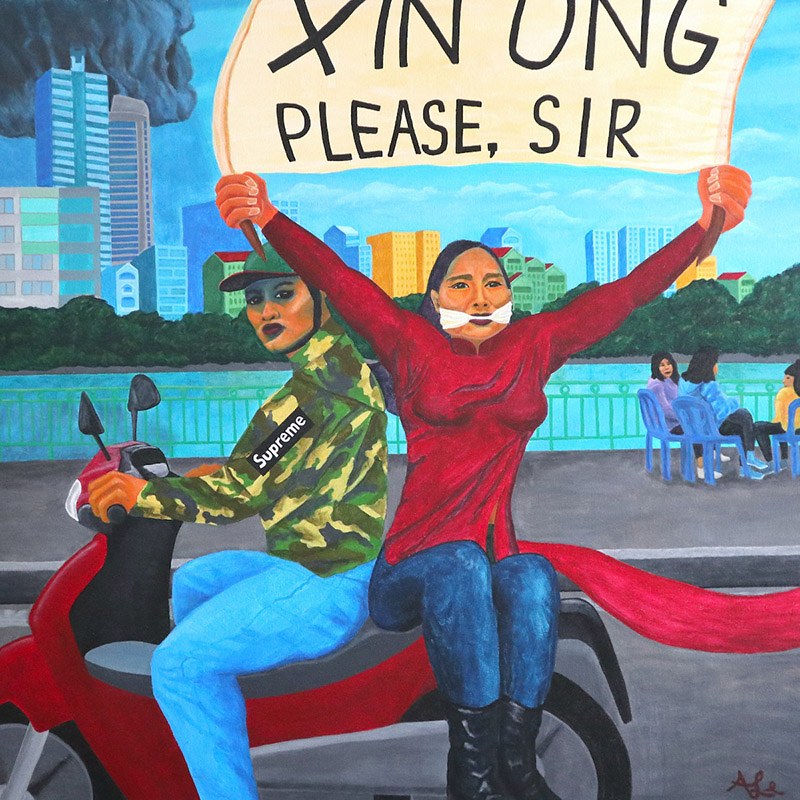
Their painting, “Open Mic,” rises from these musings and the currents of a turbulent world. The title—a sharp play on “military-industrial complex”—captures their conflicted love for D.C., a city of liberal promise yet the heart of power without voting rights. Federal contractors loom everywhere, feeding the military-industrial machinery through weapons sales, a presence that cannot be ignored. The ongoing genocide in Palestine sears their conscience, compelling them to confront the United States’ role in exacerbating the massacre. In this act of creation, they rebel and refuse to be silent before injustice, a fierce, living embodiment of their “Model Mutiny” philosophy.
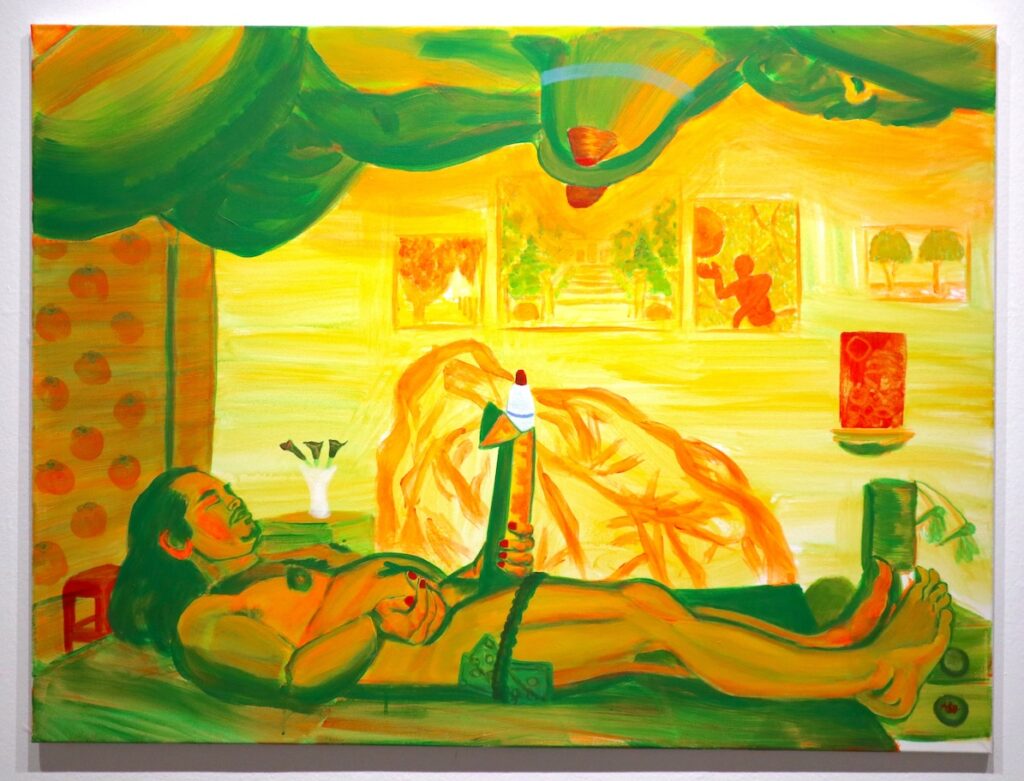
“Open Mic” depicts an interior scene, their bedroom, with their partner Ashley above them, and themself below. The central, absurd image of the Washington Monument “opening up” and “firing a missile into the world” is born from a place of dark humor, a surrealist response to the unbearable. “If you don’t laugh, you’ll cry,” they muse. The painting is rich with missile imagery, juxtaposed with elements of Vietnamese culture—a red envelope, ancestral portraits on the wall. It embodies the contradictions they feel: the sexual, pleasurable act of firing missiles intertwined with their horrifying destructive power. Amidst this, beloved scenes of D.C. like Meridian Hill Park peek through, all enveloped in the cloud of the military industrial complex. It is a raw confrontation with the disturbing realities that permeate their environment, rendered with a profound melancholy for what humanity perpetrates.
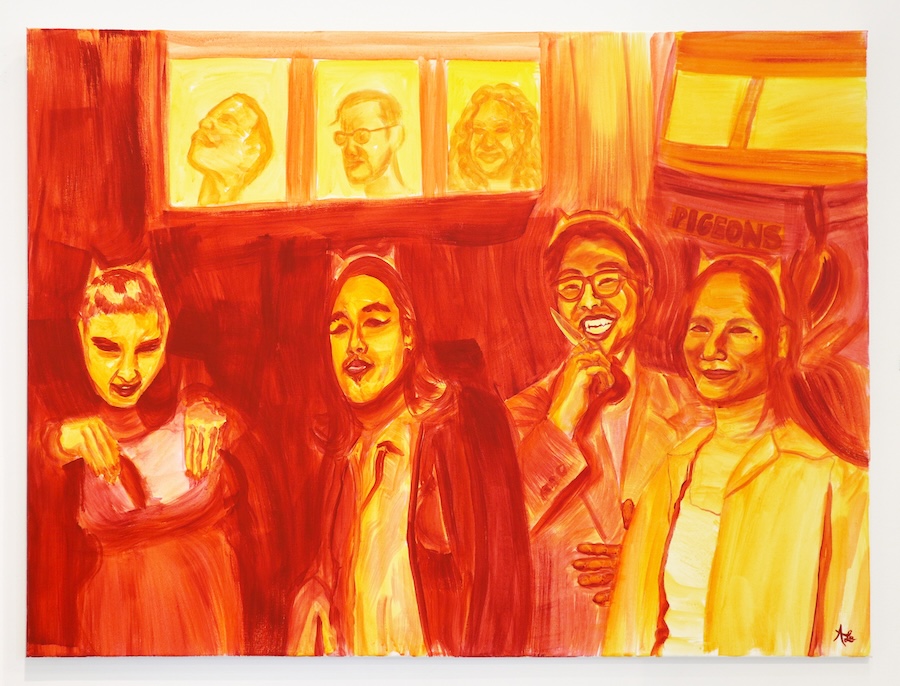
Another painting, “Vagabonds,” features their close Vietnamese friends, a celebration of solidarity and queerness. Drawing from their Catholic upbringing, where queerness is synonymous with “social deviance,” the painting reclaims this narrative. It depicts a “very red-wash” party, both alluring and “kind of dangerous,” a transitional space. “To be a ‘vagabond’ is to be in transition,” they explain, a state they deeply identify with as a Vietnamese American. It is a joyful embrace of the community they have built, a humorous poke at societal judgment—a triumphant mutiny against societal norms, solidifying the essence of Model Mutiny through chosen family and shared identity. Estrangement, and all its brooding kin—loss, melancholia—has always haunted the arts and literature. Paradoxically, or perhaps essentially, art becomes the site of community-building for justice and resilience.
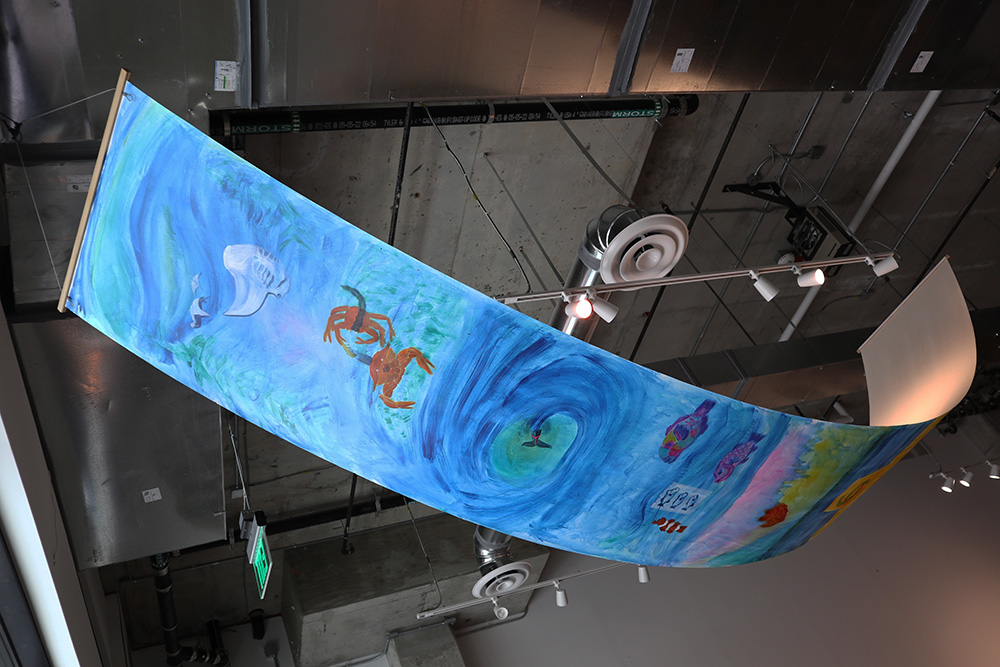
Currently, Anthony embarks on their largest painting yet, a piece that revisits the concept of “coming home.” Through their art and therapy, they diligently work to normalize asking questions, to make the implicit explicit, and to explore heritage with less shame and more joy. This new work features “anthropomorphic symbolism,” a metaphor for queerness. Their obsession with pigeons, their beauty, their proud presence in cities yet their frequent invisibility, resonates with their experience as a queer person. Their friends appear as pigeons and other “weird anthropomorphic creatures,” celebrating the inherent strangeness and uniqueness of each individual. The painting, planned to hang from the ceiling in a bowl shape, reveals a “land side” and “underwater world,” a meditation on the convergence of heritage, home, and queerness. This ambitious work debuts at the Queer Art Salon in June 2025, an act of intentional community building in the face of estrangement, and a vibrant expression of Model Mutiny.
Beyond painting, Anthony expands their artistic reach into writing. Their Vagabond zine project, funded by a grant, brings together thirteen Vietnamese artists—visual artists, poets, musicians, writers. Collaborating with Philippa Hughes, who also has Vietnamese heritage, they interview each artist and commission them to write “a letter to their younger selves as an act of self-love.” This project manifests their belief in promoting self-love and validating diverse experiences. The zine, launched in June 2024 with an outdoor exhibit, celebrated the expansive nature of Vietnamese identity, an enduring resistance to the insular, confining box Anthony felt trapped in as a child. They aim to uplift visual artists within the rich tradition of Vietnamese writers and poets, fostering a broader dialogue – a powerful act of mutiny against artistic silos and a nurturing of collective memory and resilience, fully embodying the spirit of Model Mutiny.
Their advice for younger artists is simple yet profound: “Making art is really about going deep, and it is about vulnerability.” It is about revealing something “uniquely yourself,” even when it feels exposed or like sharing secrets. This vulnerability is the key to discovering “what you’re made of,” the root of the ideas one can offer the world through art. They acknowledge the commercial path, but their choice is to create art not primarily for sale, but for sharing, for connection. “It’s really about sharing parts of myself by being vulnerable,” they explain, “that I hope will affect you in some way.” They believe good art is that which makes people think differently, offering new perspectives on their own lives. All political agendas are transient. Art outlives them by preserving human stories and sustaining their strength. It documents both displacement and emplacement, against all odds. An enduring art is one that not only refuses to unconsciously conform to the master’s law, but dares to create a law of its own—out of the utmost freedom of creativity. This is the ultimate promise of Model Mutiny: a defiant, creative freedom that outlives and transcends oppressive structures.
Amidst the swirling kaleidoscope of their canvases, Anthony Lê, an alchemist of being, performs. The very intersections of their Vietnamese, American, non-binary, and queer selves transform disparate narratives into a resonant, harmonious whole. Here, within the hallowed confines of their studio, memory, melancholy, and mutiny are vital pigments on their palette, unfurling their just art—an audacious declaration of Model Mutiny—a self unmoored.
Author
Quỳnh H. Võ is a literary scholar, writer, and translator (Vietnamese/English) based in Washington, D.C., where she teaches and researches global Asian literature and culture at American University. She is a co-author (with Dr. Tung Bui, University of Hawai’i at Mānoa) of The Making of Little Saigon: Narratives of Nostalgia, (Dis)enchantments, and Aspirations (Bloomsbury, 2024), and a co-translator (with Dr. Quan Manh Ha, Univer-sity of Montana) of Longings: Contemporary Fiction by Vietnamese Women Writers (Texas Tech University Press, 2024). Her essays, translations, and editorial work have appeared in Los Angeles Review of Books, diaCRITICS, Saigoneer, Words Without Borders, World Literature Today, Metamorphoses, Asian Literature and Translation, Journal of Vietnamese Studies, and elsewhere.
